2026 Drop Predictions: AI Bots, Fair Queues, and What's Next
2026 Drop Predictions: AI Bots, Fair Queues, and What's Next
2025 was the stress test. 2026 is the reckoning.
For the first time in a decade, bot traffic now exceeds human traffic on the internet: 51% of all web requests are automated. The DOJ is actively trying to break up Live Nation. The FTC is pursuing penalties described as "hundreds of billions of dollars." And 64% of consumers have made their verdict clear: the way drops work today is fundamentally unfair.
The brands that recognized this shift early are already building for what's next. The ones still patching legacy systems with band-aids? They're about to learn some expensive lessons.
Here are five predictions that will reshape hype commerce in 2026, and what you should be doing about them right now.
Prediction 1: The Bot Arms Race Reaches Its Endgame
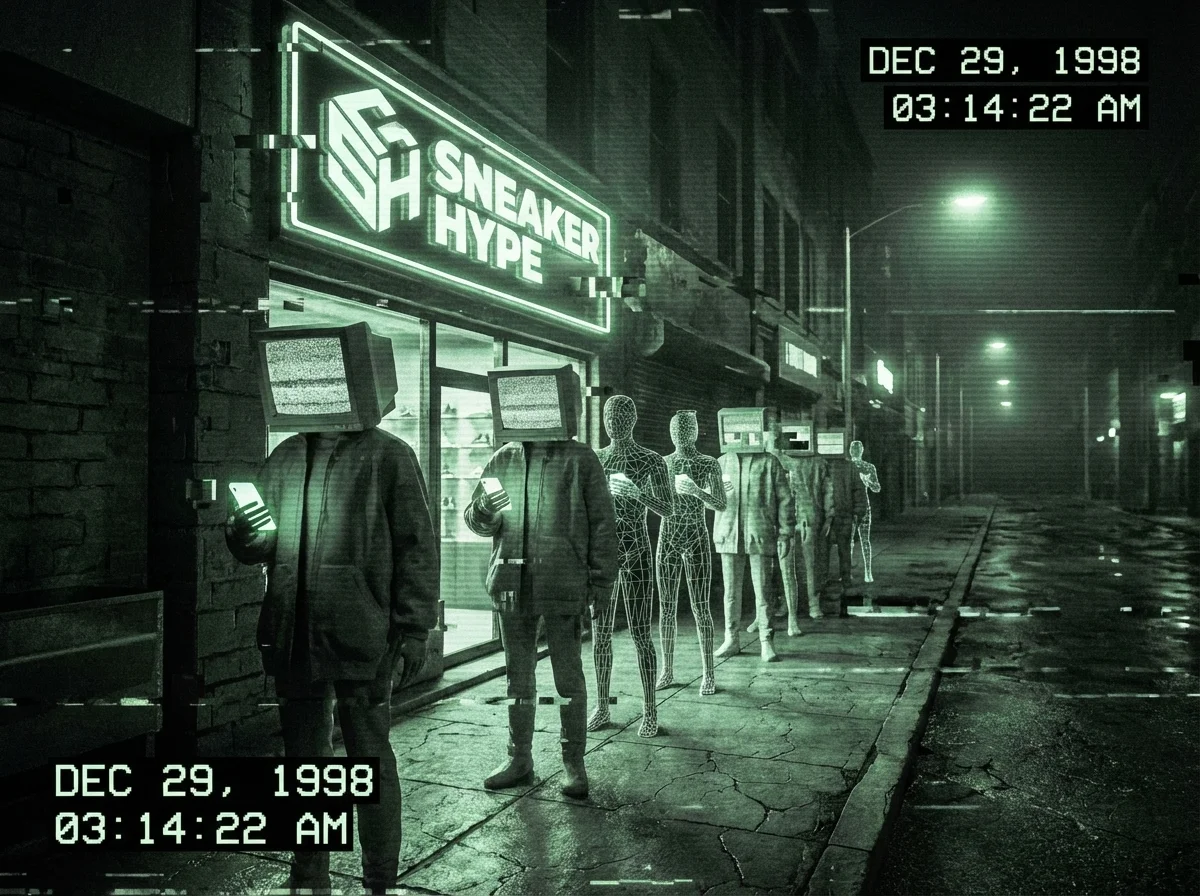
The bots have won. Not in some distant dystopian future. Right now.
ETH Zürich researchers achieved a 100% success rate bypassing Google's reCAPTCHA v2 using fine-tuned AI models. Advanced bots go undetected 95% of the time. During a recent top-10 sneaker brand drop, 97% of traffic came from bots. Of 1.7 million visitors, fewer than 100,000 were actual humans trying to buy shoes.
Let that sink in: for every legitimate customer in line, there were 16 bots cutting ahead.
The economics have democratized too. CAPTCHA-solving services now cost $0.04 per 1,000 requests. Residential proxy networks (used in 21% of all bot attacks) let bad actors mask their traffic as ordinary home internet connections. The bot-as-a-service ecosystem means anyone with a credit card can deploy sophisticated automation without writing a single line of code.
What dies in 2026: CAPTCHAs. IP blocking. Rate limiting. Every traditional defense built on the assumption that bots are dumber or slower than humans.
What survives: Behavioral biometrics analyzing thousands of signals: typing patterns, mouse movements, touch gestures, device handling. Solutions that build per-customer baselines and detect anomalies specific to your traffic patterns. Identity verification that knows a phone being held upside down means it's in a phone farm.
The behavioral biometrics market is projected to hit $14 billion by 2032 for a reason. It's the only thing that works.
Prediction 2: Regulation Gets Teeth (Sharp Ones)
Remember when the BOTS Act sat dormant for eight years with a single enforcement action? Those days are over.
The regulatory environment transformed from passive observer to active prosecutor starting with Taylor Swift's Eras Tour debacle in November 2022. Now the consequences are materializing:
United States: The DOJ's May 2024 antitrust lawsuit against Live Nation, joined by 40 state attorneys general, explicitly seeks to break up the company. Attorney General Merrick Garland didn't mince words: "It is time to break it up." The FTC followed with allegations that Ticketmaster earned $3.7 billion in resale revenue and $6.4 billion in hidden fees from 2019-2024. Potential penalties? Hundreds of billions, given the per-violation structure.
State Level: Arizona's "Taylor Swift Bill" imposes $10,000 fines per violation for bot use. Minnesota banned speculative ticketing entirely as of January 2025. More states are following.
UK: The Competition and Markets Authority's investigation into the Oasis sale resulted in legally binding requirements for 24-hour advance notice of tiered pricing. The new Digital Markets, Competition and Consumers Act gives regulators power to impose fines up to 10% of global turnover, without court action.
EU: The Digital Services Act mandates trader verification, prohibits dark patterns, and requires annual transparency reports. Each member state now has enforcement powers.
What this means for 2026: The era of "ask forgiveness, not permission" is ending. Brands that can't demonstrate fair-access practices will face regulatory scrutiny whether they're the ones selling tickets or the ones selling limited-edition sneakers. The playbook that worked in 2020 is now a liability.
Prediction 3: Fair Access Becomes a Brand Differentiator
Here's the number that should keep every brand executive up at night: 64% of consumers consider dynamic pricing and bot-driven scarcity fundamentally unfair.
Not "mildly annoying." Not "somewhat frustrating." Fundamentally unfair.
The Oasis ticket sale crystallized this sentiment when government ministers publicly complained about paying £350 for tickets advertised at £148.50. But the frustration extends far beyond ticketing. Sneaker consumers consider bots "ethically shameful" and increasingly blame the brands (not just the botters) for systems that feel rigged.
Consumer expectations have shifted permanently:
- 70% prefer virtual queues or appointments over first-come-first-served chaos
- Frustration with queuing increased 126% year-over-year
- 94% of consumers are more likely to be loyal to brands demonstrating complete transparency
- Companies with transparent pricing policies see 15% growth in market share
The secondary ticket market has swelled to $28.2 billion, projected to reach $73.4 billion by 2033. That's not consumers happily paying premium prices. That's desperation to escape broken primary systems.
The 2026 shift: "How you drop" becomes as important as "what you drop." Brands will compete on demonstrated fairness metrics the way they once competed on exclusivity alone. Ticketmaster's Verified Fan program already shows the appetite: only 5% of those tickets end up on secondary markets versus 20-30% during standard sales.
The brands that figure this out first capture loyalty that competitors can't buy back with marketing spend.
Prediction 4: The Death of "Good Enough" Infrastructure
Only 2.8% of websites are fully protected against advanced bot attacks. Down from 8.4% the previous year. The defenses are getting worse, not better.
Why? Because most e-commerce infrastructure was built for steady-state traffic, not stampedes. It's London's Victorian sewer system: a marvel of engineering for daily flow, catastrophic failure during once-in-a-century storms.
The Nintendo Switch 2 pre-order disaster proved this definitively. Target crashed in seconds. Best Buy queues froze for hours. GameStop threw "bad gateway" errors. These aren't scrappy startups. They're retail giants with massive IT budgets. And they all failed the same way, at the same moment, for the same reason: their infrastructure wasn't built for hype-scale events.
The math has changed. Retail e-commerce loses $1.1 million per hour of downtime on average. But the real cost isn't the downtime. It's the trust destruction:
- 55% abandon purchases immediately after technical issues
- 50% switch to competitors after one bad experience
- 32% stop buying from brands they loved after a single failure
- Replacing churned customers costs 5x more than keeping them
The 2026 reality: Retrofitting stops working. You can't patch your way to hype-readiness. The frame wasn't designed for those G-forces.
Purpose-built drop platforms become standard for any brand serious about high-traffic launches. The cost of chaos now exceeds the cost of change, and CFOs are starting to notice.
Prediction 5: Community Beats Hype
SKIMS hit $4 billion valuation using Kim Kardashian's 364 million Instagram followers. But here's what most brands miss: the tactics that powered that growth are completely replicable without celebrity co-signs.
The proof is everywhere:
Telfar went from $100K to $1.6M in annual revenue, without a single Kardashian. When Beyoncé name-dropped the "Bushwick Birkin" in "Summer Renaissance," no check changed hands. The brand had transcended influence to become culture.
Stanley transformed from a flat $73M business selling thermoses to construction workers into a $750M phenomenon, powered by three female bloggers who saw what Stanley's entire C-suite missed. Suburban moms and car cup holders beat celebrity endorsements.
Dr. Squatch built a $2 billion valuation on one YouTube ad featuring a comedian saying "Your soap is sh*t." Character beat celebrity.
The data confirms the shift: nano-influencers (1K-10K followers) get 13.33% engagement on TikTok. Macro-influencers? 0.61% on Instagram. The creators who matter aren't walking red carpets. They're in Discord servers at 2 AM answering questions about protein timing.
The 2026 playbook: Micro-influence over mega-celebrity. Fan-first strategies over scarcity manipulation. Authenticity as the ultimate growth hack.
Your next million customers aren't following celebrities. They're following creators who look like them.
What This Means For You
The window to prepare is closing. Here's what retail and commerce leaders should be doing right now:
Questions to ask your team:
- What percentage of our drop traffic is bots? (If you don't know, assume it's worse than you think.)
- Can our infrastructure handle 10x normal traffic in a 60-second window?
- How would we demonstrate "fair access" if a regulator asked tomorrow?
- What's our cost-per-incident when launches fail?
Questions to ask your vendors:
- How does your bot detection work against AI-powered bots that solve CAPTCHAs 100% of the time?
- Can you show me behavioral analysis across how many signals?
- What happens when traffic spikes 20x in the first minute?
- How do you handle queue fairness: speed-based or randomized?
Actions for Q1 2026:
- Audit your current drop infrastructure against hype-scale requirements
- Map your regulatory exposure across US, UK, and EU frameworks
- Identify community-building opportunities that don't depend on celebrity partnerships
- Build the business case for purpose-built drop infrastructure (hint: the cost of one major failure usually exceeds annual platform costs)
The Bottom Line
2025 stress-tested everything. Sites crashed. Regulators mobilized. Consumers lost patience.
2026 is when the bill comes due.
The brands that thrive won't be the ones with the biggest servers or the most famous ambassadors. They'll be the ones who understood that the frenzy is a feature, but the chaos was always optional.
Fair access isn't just good ethics anymore. It's good business.
The question isn't whether you'll adapt. It's whether you'll do it before your competitors capture the loyalty of fairness-seeking consumers who aren't coming back once they've found brands that treat them like people instead of traffic.
The reckoning is here. Are you ready?
WANT TO TURN YOUR NEXT LAUNCH INTO AN EXPERIENCE?
Join the waitlist to get early access to Fanfare and start building a community of fans, not just customers.