
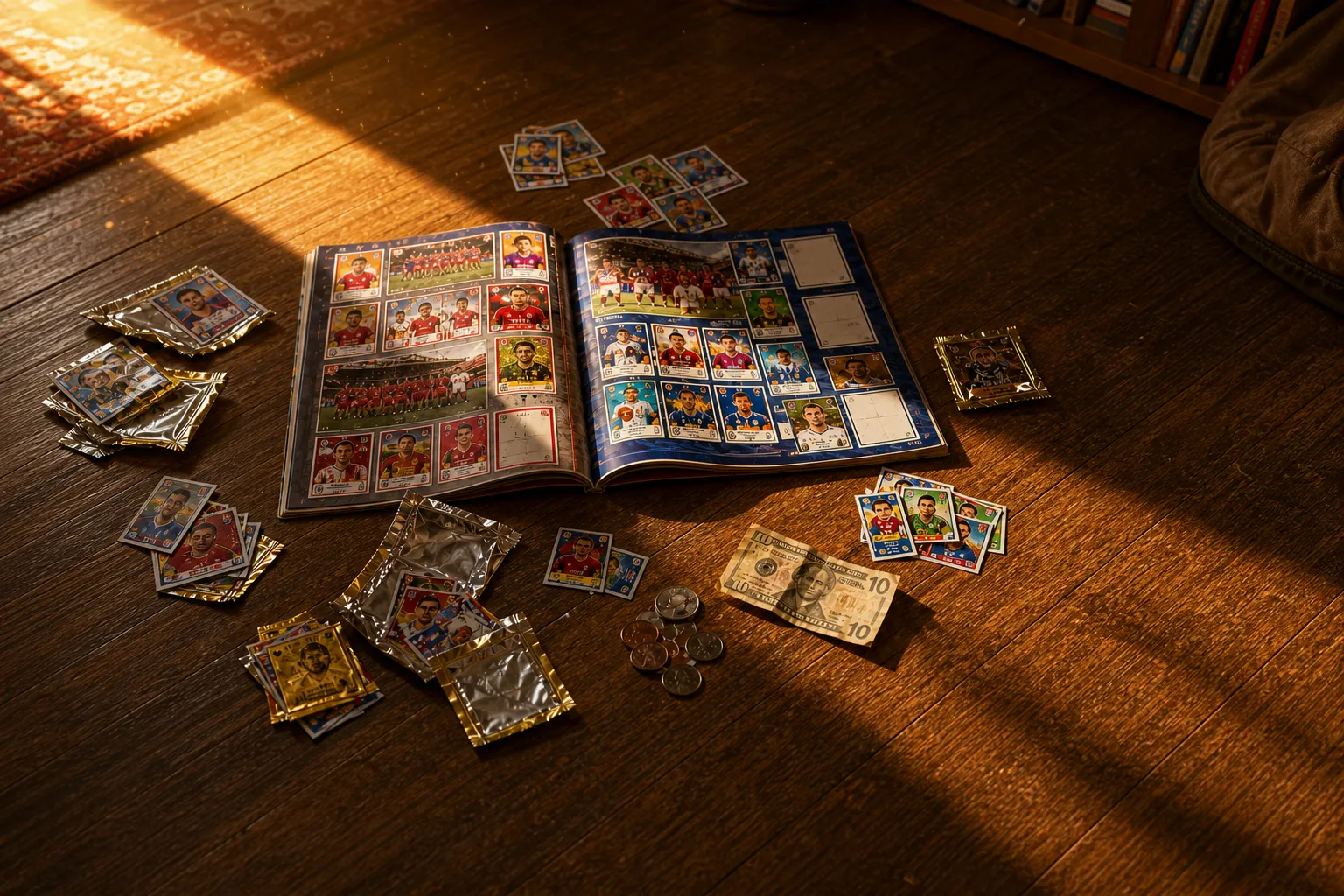
$10,990 for Category 3. $9.99 for the Sticker Album.
$10,990 for Category 3. $9.99 for the Sticker Album.
On May 8, a nine-year-old in Newark walked into a Target with a folded $10 bill from her grandmother and bought her first Panini World Cup album. Same store, same Saturday, same FIFA-licensed shelf space.
That same day, FIFA's ticketing portal opened a fresh inventory drop. Opening match seats started at $2,030. Final tickets topped out at $10,990. By the following week, FIFA had quietly retired the $10,990 figure on the final and replaced it with a new "Front Category 1" tier priced at $32,970.
Both products are official 2026 FIFA World Cup merchandise. Both carry the same governing-body logo. Both are sold to fans who want a piece of the same tournament.
One of them generated a class action investigation, a 69-member congressional letter, and a petition from the Democratic nominee for mayor of New York. The other one sold out of display boxes in 48 hours and made a kid in Newark feel like she owned a tiny shard of the World Cup.
The gap between those two outcomes is the entire story of what "fair access" means in 2026.
The FIFA Problem
Let's run the numbers in order, because the numbers are the story.
December 5, 2025: FIFA opens post-draw ticket sales. Top final seat: $8,680. Group stage Cat 3 floor: $140. By 2018 World Cup bid-book standards, where the United States, Canada, and Mexico promised a $1,550 ceiling on final tickets, FIFA was already five and a half times over the line.
April 1, 2026: Last-Minute Sales Phase opens. The final ticket ceiling jumps to $10,990. Category 2 goes to $7,380. Category 3, which is the back-of-the-stadium nosebleed seat your dad always pretended was just as good, costs $5,785.
Early May 2026: FIFA introduces Front Category 1. Final tickets relisted at $32,970. The $10,990 sticker price gets reassigned to wheelchair and easy-access amenity seats. Final tickets are now roughly twenty-one times the bid-book ceiling.
May 12, 2026: A reseller lists a single Cat 1 final seat on FIFA's own resale marketplace for $2,299,998.85. Another asks $11,499,998.85. FIFA president Gianni Infantino, asked about it at the Milken Institute, jokes: "If somebody buys a ticket for the final for $2 million, I will personally bring a hot dog and a Coke."
That's the joke FIFA is telling about its own product.
The fans are not laughing. Washington D.C. firm Migliaccio & Rathod LLP opened a formal pre-litigation investigation on April 9, citing fans who paid premium prices based on a seat map "presented as indicative of where seats would be located" and were assigned to corners, behind-goal sections, and upper decks. One fan, identified only as Nick, told The Athletic: "It's just hard to not feel scammed and/or bamboozled."
Meanwhile, in March, 69 House Democrats sent Infantino a letter calling the 2026 tournament "the most financially exclusionary and inaccessible to date." Zohran Mamdani, the Democratic nominee for NYC mayor and a lifelong Arsenal fan, launched a "Game Over Greed" petition the same week. His pitch was direct: "That means you can buy a ticket for 60 bucks and resell it for $6,000. Unlike the last three World Cups, there's nothing set aside for residents." Football Supporters Europe and Euroconsumers filed a joint complaint with the European Commission on March 24.
And here's the data point that should haunt every retailer reading this: as of April 10, FIFA had sold 40,934 of roughly 69,650 available tickets for the USA opener against Paraguay at SoFi Stadium. Fifty-nine percent. Two months from kickoff. For a home-nation opener.
Premium pricing only works when the premium is real. When you price a product like Hermès and deliver it like an obstructed-view bleacher seat, you don't have a luxury brand. You have a lawsuit.
Then there's the resale haircut. FIFA charges 15% to the buyer and 15% to the seller on every ticket that moves through its official Resale Exchange. Thirty percent. For comparison, Qatar 2022 capped resale fees at no more than 5% or $0.50, whichever was greater. The 2026 seller fee alone is roughly six times what Qatar charged. So FIFA sells the ticket once at a dynamically priced retail, then earns again on every secondary market trade it forced the fan into by pricing the primary out of reach.
This is the part where someone in the comments will tell you the prices are "just supply and demand." Sure. The supply is one stadium. The demand is engineered by FIFA telling fans for two years that this would be the most accessible World Cup ever, then quietly redefining "accessible" to mean "you can apply for a lottery and maybe get into a queue."
The CMA investigation into the Oasis reunion tour offers a useful parallel. Ticketmaster faced identical fan outrage in September 2024 when prices on the standing-room tickets jumped from $100 to $466 mid-queue. The UK regulator concluded in March 2025 that Ticketmaster had used tiered-release pricing, not real-time algorithmic dynamic pricing. FIFA, by contrast, has openly confirmed it is using algorithmic variable and dynamic pricing. Whatever Oasis fans were furious about, FIFA is doing the actual thing.
The Panini Counter
Now look at what's happening on the other shelf.
The 2026 Panini FIFA World Cup Sticker Album is the largest in the company's fifteen-edition history. 980 stickers. 112 pages. 48 teams. Each team gets a 20-sticker spread, eighteen players plus the team photo plus a foil federation badge. Sixty-eight special-edition stickers on top. Fifty foils. A full sticker for every player who has any reasonable shot at the tournament roster.
The pricing tells a different kind of story:
- Album, standalone: $9.99 at retail. $3.75 at the Gold River wholesale level.
- Pack of seven stickers: £1.25, roughly $1.60.
- Starter pack (album plus four packs): $6.40.
- 50-pack display box (the wholesale unit kiosk owners and Targets stock): $75.
There's no algorithmic pricing engine here. No queue. No "Front Category" tier. There is one MSRP for a pack, and that MSRP applies whether you're buying it at the Walmart in Newark, the Sainsbury's in Croydon, or the kiosk in Buenos Aires that ran out three days into the launch.
And then, layered on top of retail, the Coca-Cola partnership: more than one billion promotional stickers distributed under bottle labels globally. Three hundred and fifty million of them inside U.S. Coca-Cola products alone. The mechanic is exactly as dumb and joyful as it sounds: you peel back the label, you get one of twelve Coca-Cola-exclusive stickers, you scan a code, you get a free digital pack in the Panini app. Lamine Yamal, Harry Kane, Joshua Kimmich, Erling Haaland. Free, with a Coke.
The album has a designated two-page spread reserved for the Coca-Cola twelve. You literally cannot complete the album without engaging the sponsorship activation, which sounds cynical until you realize it means the activation is also free, repeatedly, in every bottle of Coke for ten weeks.
Mark Warsop, CEO of Panini America, framed the strategy when the partnership launched: "Panini stickers are more than collectibles. They're a shared tradition that connects generations of fans to the FIFA World Cup."
Notice what's not in that quote. "Premium." "Exclusive." "Market rates." It's the inverse of every word Infantino used at Milken.
Forty percent of Panini's collectors are now adults. The brand knows exactly who is buying. It's the same people FIFA priced out of the stands, except those people are now spending $1.60 to buy their kid one of the foil badges they themselves traded for in a school cafeteria in 1994. The math works because the audience is the math.
There's still scarcity in this system. The hyper-rare Black 1-of-1 parallels are real. The 2022 Messi Black sold for $139,200 at auction after Argentina won Qatar. Beckett has the Prizm hobby checklist breakdown if you want it. But that scarcity sits on top of an open-edition base. The kid in Newark and the collector hunting for the Wirtz autograph card on May 22 are on the same playing field at the entry point. The same Saturday. The same Target. The same $9.99 album.
Both Are FIFA Merchandise
Here is what should keep retailers up at night: these two products are licensed by the same governing body. FIFA approved both. FIFA shares revenue with both. FIFA gets to choose which one represents the brand to a kid encountering the World Cup for the first time.
It picked both. And the gap between them is now the gap between a class action and a charity drive.
Look at the regulatory exposure on each side. FIFA: federal class action investigation, EU consumer complaint, congressional letter, mayoral candidate petition. Panini: a Wembley launch event with David James, John Barnes, Gary Cahill, and Adam Lallana. The most recent comparable Panini "crisis" was the 2022 Argentina shortage, which resolved when Panini agreed to increase production by 20%. The fix for Panini's worst-case scenario was: make more product, more affordable, faster.
This is what makes the contrast useful for everyone selling anything in 2026, not just stadium operators. You always have two commerce surfaces. You always get to choose which one carries your brand into the moment everyone's watching.
You can run the FIFA surface: variable pricing, opaque queues, premium tiers stacked on premium tiers, resale fees on the back end, lawyers in the inbox. You can defend it the way Infantino defended it, with phrases like "market rates" and "developed entertainment economy" and hot dog jokes.
Or you can run the Panini surface: open-edition core, predictable pricing, retail distribution that treats every kid the same, scarcity layered on top as a chase mechanic rather than as the front door. You can make the moment something fans share rather than something they pay rent for.
There's no neutral position. The pricing model you choose is the brand you're building.
The Fanfare Take
Drop culture, done right, is not about gating people out. It is about making the moment feel earned without making it feel rigged.
That's the part FIFA missed. The supply genuinely is scarce, the world genuinely is watching, the fans genuinely want in. That's a textbook drop setup. Then FIFA inverted it. Dynamic pricing on a finite seat count is not scarcity creating value. It is rent extraction wearing a scarcity costume.
Panini got it backwards-correct. The base product is open edition. Everyone gets to play. The chase parallels, the hobby boxes, the Black 1-of-1, those are the limited drops. You earn them by showing up, by trading, by getting lucky, by being part of the culture. They reward fandom, not solvency.
Create. Drop. Reward. That's the loop we build for. Not "premium tier the fanbase out of the stadium." Not "monetize the resale of the product you already monetized." A drop that fans show up to, an experience that doesn't punish the kid with the folded ten-dollar bill, and a long tail of rewarded loyalty that makes them come back next time.
If you're a brand running anything in a moment of high cultural attention this summer, World Cup or otherwise, the question is not whether to drop. The question is: which surface are you running it on?
Because the fans can already tell the difference. The kid in Newark has her album. She can name every player on the U.S. roster. She does not know yet that FIFA charged $32,970 for the final, and when she finds out, she will not forget which brand let her in.
Your next drop doesn't need to price anyone out to prove it matters. It needs scarcity that rewards fans, pricing that doesn't insult them, and infrastructure that holds when the moment lands.
Let's build the one that gets remembered for the right reasons.
WANT TO TURN YOUR NEXT LAUNCH INTO AN EXPERIENCE?
Join the waitlist to get early access to Fanfare and start building a community of fans, not just customers.