
They refunded the brokers. They kept the markup.
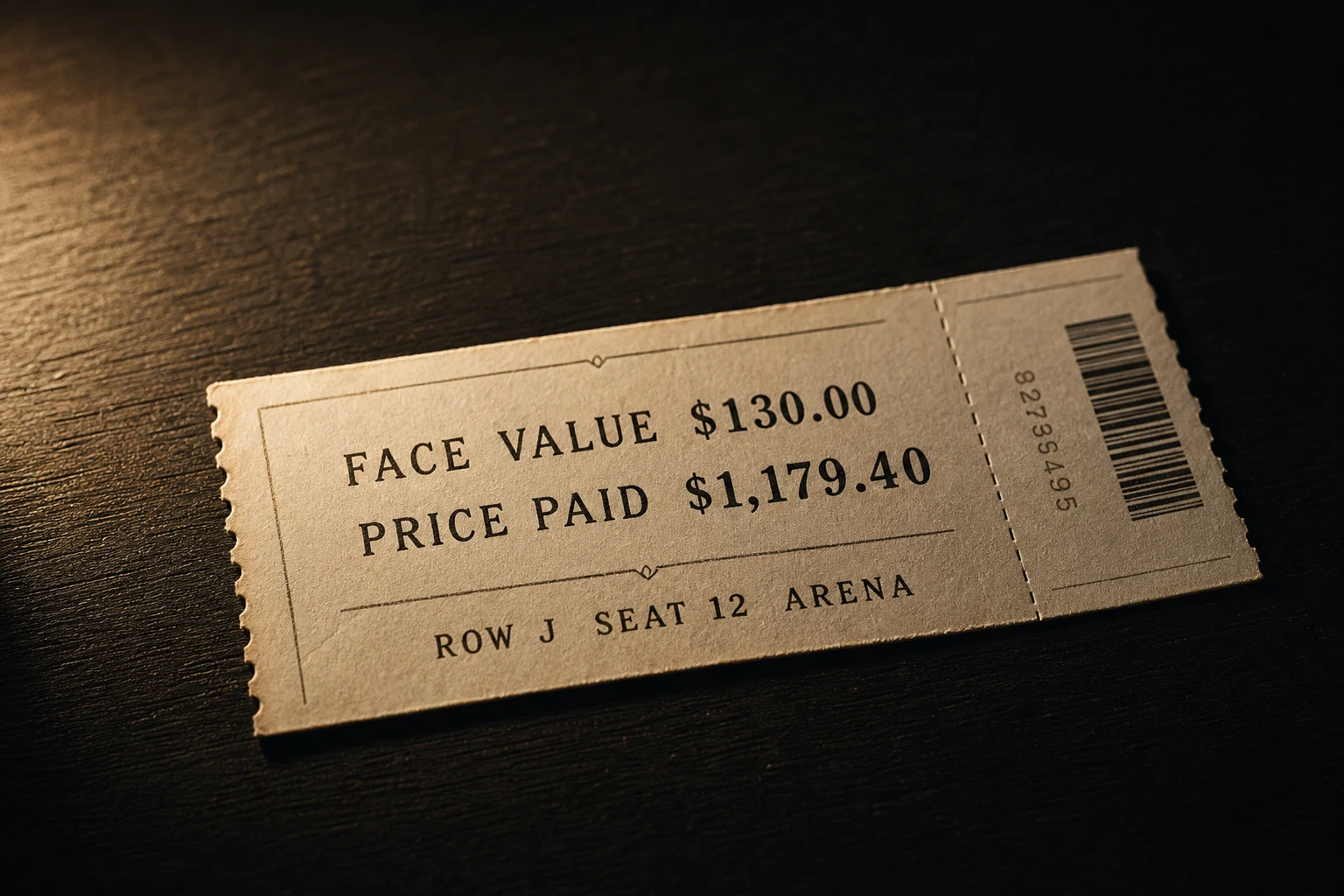
Section 118, row 7, Madison Square Garden. In January, that seat sold for $1,179.40, marked "Official Platinum." In April, Ticketmaster's Global President published a letter explaining that the actual face value of the seat was under $130, all-in.
Both prices were Ticketmaster's. The fan in section 118 paid the difference.
On April 22, Ticketmaster's new Global President Saumil Mehta announced the company had identified and canceled thousands of scalped tickets to Harry Styles' "Together, Together" Madison Square Garden residency. The accounts had used multiple identities and fake registrations to evade purchase limits. None of the canceled tickets had reached fans yet. Ticketmaster would re-release them at original prices in a request window from April 30 to May 1.
The cheapest inventory was being protected. The framing was airtight. Mehta included the percentages: 19% of the tour's tickets had been priced at $50, 77% under $95, 100% under $130, all-in.
Then he closed: "I come from a fintech background. Fraud evolves and so do we."
Three days earlier, on April 15, a federal jury in Manhattan found that Live Nation and Ticketmaster operated as an illegal monopoly. NPR put the consumer overcharge at $1.72 per ticket across 22 states. Six days before that, the FTC announced StubHub would pay $10 million to settle violations of the Fees Rule. Six weeks earlier, the Senate Permanent Subcommittee on Investigations had released a report documenting that Ticketmaster's own internal records contradicted the position it took in public.
That's the eight-day window the cancellation announcement sat inside. The press release reads differently when you read it that way.
The carve-out is the trick
Ticketmaster's announcement covers a specific class of inventory: tickets it had flagged as held by scalpers, priced at the original face value Ticketmaster says it never sold them at. Those are being routed back to fans through a request program at $50, $95, $130.
There is another class of inventory Ticketmaster's announcement does not cover. The fan who paid $700 for a lower-bowl seat during the January presale. The fan who paid $1,000+. The fan in section 118, row 7. Those tickets were sold by Ticketmaster directly to fans, not to brokers. They were priced through Ticketmaster's dynamic-pricing tool, which Ticketmaster operates and profits from. None of those buyers are getting refunds. None of them are mentioned in the letter.
The fan reactions in the reply threads to the announcement were not subtle about this. TicketNews aggregated the responses on April 22 in a piece headlined "Ticketmaster Cancels Scalped Harry Styles Tickets, But Fans Say It's Dodging the Real Problem." One fan named in the piece said her tickets were $700 each and asked how that squared with Ticketmaster now claiming the original price was $130. Another fan asked whether dynamic-priced buyers would get any help. A third pointed out that fans in the same section as a request-program winner will have paid 8x as much.
This is what is happening: the buyer who pays $130 for a seat through the request program will be sitting next to a fan who paid $1,000 for the same row. Both are real fans. Ticketmaster is helping one and not the other. The one it is helping is the one it didn't directly profit from.
Jack Antonoff, on April 22, quote-tweeted the announcement with three words: "you caught you?"
He's right. The brokers Ticketmaster caught are downstream of the dynamic pricing Ticketmaster created. The "real fans" Ticketmaster is rescuing are the ones it had room to rescue. The fans it is not rescuing are the ones it priced into four figures itself.
And dynamic pricing is not something the platform is reluctantly along for at the artist's request. A March 2026 Senate Permanent Subcommittee report on 112,000+ pages of Ticketmaster's internal documents shows the company actively pitching artists to expand "Official Platinum" allocations from a 4% floor toward an 8–10% "standard." That is the platform pushing the lever, not the artist. And because Ticketmaster's service fee scales with the ticket price, every upward tick on the visible price ticks Ticketmaster's revenue up with it.
The fan in section 118 row 7 saw "Official Platinum." She paid $1,179.40. Mehta's own letter says the floor on that seat was $130. The label she saw didn't tell her that. Six months later, Ticketmaster's letter announces it is protecting fans from people who would have paid $130 and resold at $400. The fans who paid $1,000 directly to Ticketmaster (same seats, same rows, same residency) are not mentioned in the letter, are not eligible for the request program, and are not being refunded the difference.
This is what the house plays cop and casino looks like in practice.
Trust lost in the queue can't be refunded by canceling brokers
The April 22 announcement is a queue story, not a refund story. Ticketmaster's queue showed fans the Platinum number. That's the moment the brand promise was made and broken. The cancellation is what happens after, with inventory the queue didn't sell to those fans in the first place.
Refund policies are a useful place to draw lines. They are not the place where queue trust gets rebuilt. By the time you are issuing a refund, the version of the brand the fan met during the drop is already the version they remember. The seat is bought. The "I am here for you, the real fan" letter does not undo what the queue communicated in real time.
This is a recurring pattern. The Ariana Grande Eternal Sunshine tour ran the same play earlier in 2026: Ticketmaster canceled scalper resale, redirected those tickets to fans at face value, and got the applause for the rescue. The dynamic-priced primary inventory was not part of the rescue. Both Grande's and Styles' fans were told their interests were being protected. Both times, the protection covered the cheap tier the platform didn't sell to those fans in the first place.
The defense, when you boil it down, is that those fans saw a price and clicked through. They consented. Consent in a queue is only consent when the queue tells the truth about what it's selling, and that is the line the queue stopped holding.
There is a version of this where the queue itself communicates what is actually happening. Tier transitions get flagged in real time. Price ranges get disclosed up front. The fan in the queue is given the information she needs to walk away or stay. The UK Competition and Markets Authority required exactly this from Ticketmaster in September 2025 in the Oasis case: 24-hour advance notice of tiered pricing, real-time price-range disclosure, and the elimination of misleading "platinum" labels. A regulator drew the line because the queue had stopped communicating.
That's the line. Refunds are downstream. The queue is where the brand sits with the fan in the most charged 90 seconds of the relationship. Not the bot defenses behind it, not the refund policy in front of it. That moment, when the fan sees what she's buying. That's the product. Treat it that way, or accept that someone is going to write a Senate report about it later.
In January the queue told fans one story. In April the press release is telling them another. The fan in section 118 paid the difference between the two.
WANT TO TURN YOUR NEXT LAUNCH INTO AN EXPERIENCE?
Join the waitlist to get early access to Fanfare and start building a community of fans, not just customers.