Year of the Horse: 40 Brands, One Symbol
Year of the Horse: 40 Brands, One Symbol
Forty-three brands. One zodiac animal. Sixty years until the next Fire Horse.
The results? A masterclass in who actually understands cultural commerce, and who's still treating Chinese New Year like a Pantone color swatch labeled "red" and "gold."
2026's Lunar New Year isn't just another zodiac rotation. The Fire Horse (丙午年) appears once every six decades. The last time this happened, Reagan was president, the Berlin Wall was still standing, and Nike hadn't even released the Air Max yet. Brands that recognized this rarity invested accordingly. Brands that didn't? Well, they're about to become case studies in what not to do.
Let's separate the cultural investments from the creative bankruptcies.
What the Horse Actually Means (And Why Most Brands Miss It)
Before we grade the homework, let's understand the assignment.
The Horse (马) is the 7th zodiac animal, representing freedom, vitality, speed, and success. But here's what separates the A-students from the attendance-only crowd: the idiom "马到成功" (Mǎ Dào Chéng Gōng), meaning "instant success upon the horse's arrival," is one of China's most celebrated expressions.
This isn't just imagery. It's aspirational language baked into the culture for millennia.
The Fire element amplifies everything. Fire Horse energy combines passion, dynamism, and transformation, a stark contrast to 2025's introspective Snake year. Brands like On Running cleverly exploited wordplay on "马上" (meaning both "immediately" and "on horseback") in campaigns targeting young consumers who want control over their own tempo.
And about those "lucky colors" everyone defaults to: yes, red and gold work. But feng shui practitioners note that blue and black actually balance the Fire Horse's excess energy. Which explains why RIMOWA chose soft-mist blue over expected red for their collection, and why the brands that went beyond obvious palettes demonstrated actual cultural fluency.
The S-Tier: Brands That Did Their Homework
These aren't just good campaigns. They're cultural artifacts that will age well.
Marshall: Four Years of Commitment
Marshall has collaborated with Chinese artists for four consecutive years of CNY collections. This year, artist FCCK translated the zodiac into rock and music language, because Marshall understood that their audience doesn't want decorative horses. They want horses that shred.
When you've built a multi-year cultural program rather than scrambling for a one-off capsule, the authenticity shows.
Lancôme × Xu Beihong Art Foundation
Lancôme partnered with the Xu Beihong Art Foundation, referencing the celebrated "Flying Horse" painting, a national cultural asset. This isn't licensing a cute illustration. This is engaging with Chinese art history at the institutional level.
The difference between "we hired a designer who googled 'horse China'" and "we partnered with the foundation preserving one of China's most famous equestrian paintings" is the difference between performance and participation.
Prada: The Full Commitment
Prada's campaign isn't a collection. It's an ecosystem.
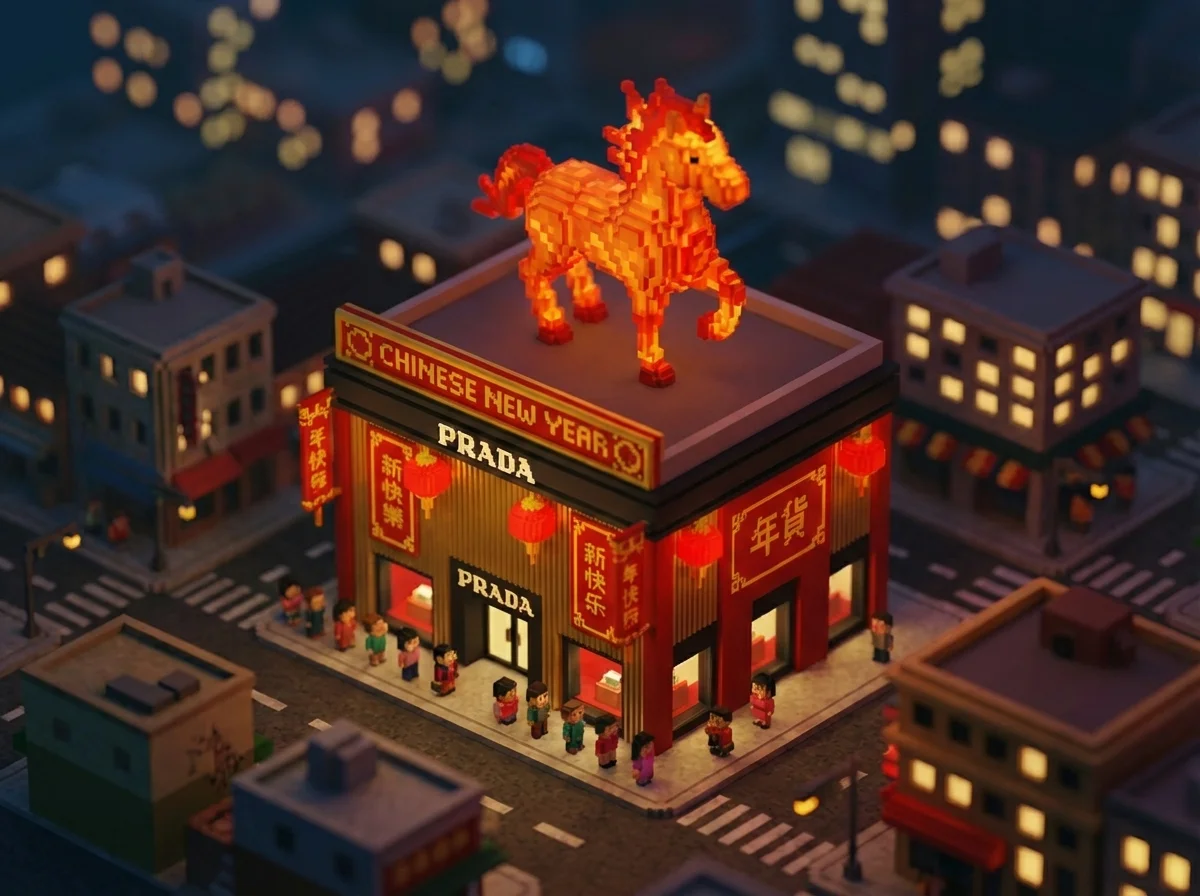
Brand ambassadors Yang Mi (113 million Weibo followers) and Olympic champion Ma Long front a campaign shot by Malaysian photographer Zhong Lin. The Prada Triangle gets reimagined as a "prism" transforming the Fire Horse into a geometric brand character. Physical installations span Shanghai's IFC Mall, Chengdu IFS, and the brand's Rong Zhai heritage house.
The finale? A "Fire Horse Fair" (February 28–March 3) featuring games, rides, and refreshments.
This is what "investment" looks like. Not a product drop. An experience calendar.
RIMOWA × Peking Opera
RIMOWA partnered with Peking opera artist Geng Qiaoyu to revive the tangma (趟马) technique, stylized galloping horse stage performance. They chose soft-mist blue (culturally appropriate for balancing Fire energy) over default red.
When your campaign requires explaining to Western audiences what tangma even is, you've gone deep enough.
Adidas China Creative Center
Adidas China moved beyond "slapping motifs on a hoodie" with Tang-inspired silhouettes, palace-skirt hems, and jade button closures. Their Creative Center Shanghai produced pieces that would work as standalone fashion. The CNY connection elevates rather than defines them.
The A-Tier: Solid Execution, Heritage Alignment
These brands had natural advantages and used them well.
Burberry created an exclusive new red Burberry Check specifically for 2026, with its Knight motif in watercolor and ink sketch techniques. Natural equestrian heritage meets natural execution. The horseshoe chain pouches ($970) and Fitzrovia trench coat ($3,850) feel like Burberry, just seasonally appropriate Burberry.
Loro Piana leveraged its equestrian heritage through the Horsey Jacket (reimagined from the 1992 Barcelona Olympics edition) and the Chandani Horse Print collection featuring concealed horse silhouettes within paisley patterns. When your brand already has horse DNA, CNY becomes an amplification opportunity rather than a pivot.
Nike's "Unbridled" Collection frames the zodiac as mindset rather than decoration. The Kobe 8 Protro "Year of the Horse" ($180-200) returns the iconic 2014 CNY colorway with Protro tech. The Ja 3 features a Chinese idiom insole reading "One horse leading the way." When your products carry meaning beyond the visuals, you've cleared the bar.
The B-Tier: Competent But Forgettable
These campaigns won't embarrass anyone. They also won't be remembered in six months.
Fendi's BFF mini charms ($1,247–$1,677) feature outfits highlighting persimmons and peanuts, a visual pun on the Chinese phrase "may everything go smoothly." Clever wordplay, solid execution, probably exactly what the brief asked for. Nothing more.
Stanley's "Red Stallion" Quencher ($45–50) features Sumi-style inkwork horses and shimmering gold accents. The marketing emphasizes Fire Horse dynamism. For a tumbler brand, this is probably peak zodiac performance. But it's still a tumbler with a horse on it.
Starbucks released a four-piece US collection with the ceramic mug cleverly playing on "Starbucks" containing "horse" + "branding." The Mr. Bearista Horse Plush Keychain ($14.95) is cute. It's all very... competent.
The C-Tier: Slap a Horse On It
We won't name every offender. But you know the pattern:
- Generic red and gold palette
- Stock horse illustration (or worse, the same horse illustration as three other brands)
- No local artist collaboration
- No physical China presence
- One-off capsule with no cultural commitment
- Product descriptions that could apply to any zodiac year if you swapped the animal
Per Dao Insights analysis: "The strongest campaigns aren't just leaning on motifs. They're playing at emotional and cultural elements that feel true to the festival. It's a cultural framework, not a creative brief."
If your CNY collection could be created by an AI fed the prompt "Chinese New Year horse product," you're in C-tier territory.
Luxury vs. Streetwear: Two Different Games
The price spectrum reveals completely different strategic approaches.
The Horological Investment
Watch brands are playing a different game entirely:
| Brand | Model | Price | Edition |
|---|---|---|---|
| Dior | Grand Soir Year of the Horse | $58,000 | 30 pieces |
| Harry Winston | Fire Horse Automatic | POA | 8 pieces |
| Jaeger-LeCoultre | Reverso Tribute Enamel | POA | 10 pieces |
| Vacheron Constantin | Métiers d'Art Chinese Zodiac | POA | 25 pieces |
| TAG Heuer | Carrera Chronograph | $11,150 | 250 pieces |
| Longines | Master Collection | $3,400 | 2,026 pieces |
These aren't products. They're collectibles that happen to tell time. The 60-year Fire Horse cycle makes limited editions actually limited, not just marketing-limited.
Streetwear's Texture Play
Jordan Brand executed its most texture-forward CNY collection yet. The Air Jordan 1 Low OG "CNY" ($140) releases February 17, the first day of Lunar New Year, with grey canvas, tonal pony hair overlays, floral embroidery, and a hidden scroll on the tongue with Chinese characters translating to "renewal, harmony, good luck."
The Air Jordan 1 High 'Xuanwu' remains the most limited release at just 3,399 pairs globally (Asia-exclusive, $355). When Asia gets exclusives before global, you know the brand understands where cultural credibility is built.
BAPE × CLOT celebrates their 20th anniversary by blending CLOT's Silk Royale pattern with BST CAMO. The Shark Full Zip Hoodie transforms the signature shark face into a dragon face while retaining signature teeth, priced HKD 799–3,499.
The Money: CNY Commerce By The Numbers
China's luxury market contracted 18–22% in 2024 to approximately €45 billion, reverting to 2020 levels. But Q3 2025 showed stabilization. LVMH reported its first quarterly sales growth in over a year.
CNY 2025 delivered:
- 501 million domestic tourism trips
- ¥677 billion ($93B) in spending
- 26.1% online retail penetration
- ~969 million mobile payment users
The demand is real. The Qeelin × Mr. Bags CNY 2025 limited set (¥14,800/$2,018) sold out in under one minute. Resale premiums for CNY products typically command 15–40%+ above retail.
But here's the shift: AlixPartners reports China's net spending intent swung from +10 percentage points (2025) to -8 percentage points (2026), the sharpest reversal among major markets. Consumers are more selective. Cultural authenticity isn't a nice-to-have; it's the filter for where money actually goes.
The Authenticity Check: Are Western Brands Getting It?
Xiaohongshu (Little Red Book) performance has become the authenticity scoreboard:
- CNY engagement surges 78% above baseline periods
- Cultural authenticity drives 2.7x higher engagement
- Research now starts 8–10 weeks before the festival
- Micro-influencers (10K–100K followers) drive 2.4x higher conversion than mega-accounts
The "Lunar New Year" vs. "Chinese New Year" terminology debate continues. Following UNESCO's December 2024 heritage designation, mainland Chinese consumers increasingly advocate for "Chinese New Year" specifically. Brands hedging with "Lunar" are noticed, and not favorably.
The clearest indicator of who's getting it right: brands treating the zodiac as a cultural framework for storytelling rather than a decoration brief for products.
The Drop Problem Nobody's Talking About
Here's where it gets relevant to what we build.
The Jordan 'Xuanwu' released 3,399 pairs for all of Asia. The Qeelin set sold out in under one minute. The watch collections number in single or double digits.
Every limited CNY drop faces the same infrastructure challenge as every other hype moment, except with additional complexity. Time zones spanning Beijing to Los Angeles. Demand curves that spike based on zodiac significance (Fire Horse > regular Horse). Regional exclusives requiring geographic verification.
When brands announce "Asia-exclusive" releases, they're not just making marketing decisions. They're making infrastructure decisions about who gets access, how queues form across time zones, and whether the 3,399 real fans get the 3,399 pairs, or whether bots celebrating their own Fire Horse year intercept them.
The brands that built cultural credibility over four years of CNY campaigns? They should probably also build drop infrastructure that respects that commitment.
The Bottom Line
Forty-three brands. One zodiac. 60 years until the next Fire Horse.
The S-tier understood this isn't a calendar event. It's a cultural moment requiring multi-year investment, local partnerships, and execution that demonstrates actual knowledge rather than Google Translate.
The C-tier treated it like Valentine's Day: swap hearts for horses, red stays red, ship it.
The market is increasingly able to tell the difference. Xiaohongshu engagement doesn't lie. Resale premiums don't lie. And the 18-22% luxury contraction means consumers are making harder choices about where cultural investment deserves their cultural spending.
The Fire Horse rewards boldness, passion, and genuine momentum.
The brands that embodied those traits? They'll be remembered when the next Fire Horse arrives in 2086.
The ones that slapped a horse on it? They'll be case studies in a blog post about what not to do.
Same as it ever was.
When limited CNY drops need fair access infrastructure that works across time zones and demand spikes, that's exactly what Fanfare builds. No bots. No broken queues. Just fans who showed up getting the shot they earned.
WANT TO TURN YOUR NEXT LAUNCH INTO AN EXPERIENCE?
Join the waitlist to get early access to Fanfare and start building a community of fans, not just customers.