

How to Run a Limited-Edition Drop Without Crashes, Bots or Unfair Access
How to Run a Limited-Edition Drop Without Crashes, Bots or Unfair Access
Short answer, for anyone with a launch date and a knot in their stomach.
You need three things. A virtual waiting room that holds the crowd so your store stays up. A line that is shuffled when doors open, or a draw, so the fastest script doesn't win. And identity checks plus purchase limits enforced at checkout, so one buyer can't take forty.
Most platforms sell you the first one. The other two are where drops go wrong.
Here's the long answer.
What Goes Wrong on Drop Day
Three failures. Usually on the same morning.
The store falls over. When Switch 2 preorders opened at midnight on April 24, 2025, Walmart, Target and Best Buy all buckled almost at once. GameStop opened eleven hours later, with all that warning, and crashed too. Its help account's line: "We're seeing overwhelming demand for Switch 2, which is causing some site issues."
The bots get there first. When Nvidia's RTX 5090 launched in January 2025, a single bot reportedly bought nearly all the Founders Edition stock at one European retailer, through links that hadn't been published yet. Cards with a $1,999 price tag resold for $4,500 and up.
The fans who did everything right lose anyway. In September 2026, Pokémon Center cancelled thousands of 30th Celebration orders a week before release. Most were reportedly bots. Some were people who had waited in the virtual line for hours.
Notice that the last one had a queue. A queue is not a plan.
Keeping the Store Up
This is the solved problem, so solve it first.
A virtual waiting room sits in front of your store and lets shoppers through at a pace the site can take. Everyone else waits on a lightweight page that costs you almost nothing to serve. Your checkout only ever meets the people being let in.
Skipping it is expensive. The median retail outage now costs $1 million an hour, and that's before anyone screenshots your error page.
Ask Kim Kardashian. When the SKIMS Valentine's Shop went live in January 2024, she had to post the apology herself: "Due to record breaking traffic and unprecedented demand... our Skims site has crashed."
One thing to check before you sign anything: how many people the plan will actually hold. Entry tiers often cap the line at a few thousand shoppers, or a few hundred. A drop is the one day you blow through that.
Fair Access: Why First Come, First Served Fails
First come, first served sounds fair. It's a speed contest, and your fans are not the fastest thing on the internet.
The research is blunt about what happens next. A 2025 study in the Journal of Retailing found that limited editions that sell out instantly make customers less likely to buy from the brand again. The sell-out you were celebrating is quietly costing you the next one.
There are two fixes, and they suit different drops.
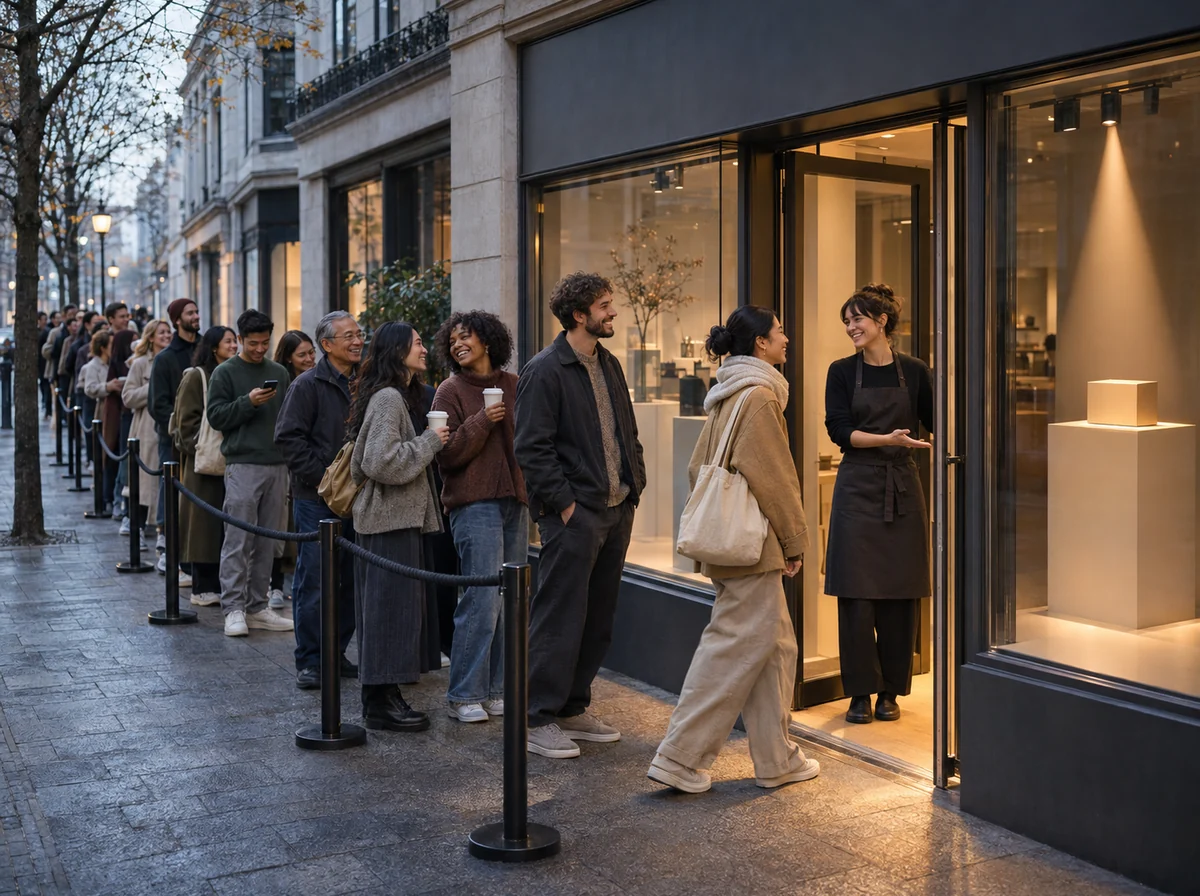
Shuffle the line. Everyone who turns up before doors gets a random place when they open. Arriving first buys nothing, so there's no reason to camp on refresh and no edge worth scripting. You keep the energy of a line without the race.
Run a draw. Entries stay open for hours or days, then winners are picked. It removes speed completely. Nintendo did this for the Switch 2 in Japan and got 2.2 million applications.
A draw has one weakness: losing five in a row feels like the game is rigged. The answer is to let loyalty count. Nintendo's own US store only invited members with a year of subscription and 50 hours of play. Give your regulars an early window, or better odds, and say so out loud.
Bots: What Stops Them and What Only Slows Them
Bots were 57% of ecommerce traffic in the 2024 holiday season. Shoppers have noticed: two in three say they regularly compete with bots for limited products.
Nobody is coming to save you, either. The US BOTS Act covers tickets. The bill that would cover retail goods, the Stopping Grinch Bots Act, has been introduced again and again since 2018 and is sitting in committee.
So it's on you. Here's the honest scorecard.
Only slows them down:
- CAPTCHAs. A 2026 study found AI agents now solve challenge CAPTCHAs almost perfectly. You're mostly annoying humans.
- A queue on its own. One operator with a thousand bots holds a thousand places in line.
- Purchase limits on the product page. Easy to dodge with more accounts.
Actually changes the math:
- A shuffled line or a draw. Takes away the speed advantage, which is the whole reason to run a bot.
- Verified sign-in and one entry per person. Every extra entry now costs the reseller a real identity.
- Limits checked again at checkout. Ten tries, one sale.
- A card hold on entry. Tying up real money across hundreds of entries gets expensive fast.
None of these is a wall. Even Nike says bots make up 10% to 50% of its draw entries. The goal is to make your drop a worse business than the next one.
A Checklist for Choosing a Platform
Six questions. Ask all of them on the demo.
- How many shoppers does my plan hold in line? Get the number in writing.
- Is the line shuffled when doors open, on my plan? Some vendors keep it for the top tier.
- Can I run a draw instead of a queue? Not every drop wants a line.
- Is the purchase limit checked at checkout, or only on the page?
- Who takes the sale? If the platform hands shoppers back to your store, everything after the door is still your problem.
- What do I know about my fans afterwards? Especially the ones who missed out.
Here's how the main options answer, as of November 2026.
| Platform | Starts at | Holds in line (entry plan) | Shuffled line | Draws | Takes the sale |
|---|---|---|---|---|---|
| Fanfare | $0 a month | No cap | Yes | Yes | Yes |
| Queue-it | $499 a month | 5,000 | Yes | No | No |
| CrowdHandler | $0, then $290 a month | 100 free, 2,000 paid | Yes | No | No |
| Cloudflare Waiting Room | Cloudflare Business plan | Not published | Enterprise add-on | No | No |
| EQL | $0 a month, fee per order | No queue | No | Yes | Yes |
The full version, with pricing sources, is on our virtual waiting room comparison.
Where Fanfare Fits
We built Fanfare for exactly this morning.
It's a virtual waiting room with no cap on the line, on any plan. The line is shuffled when doors open. Every fan signs in with a one-time code and gets one entry. The limit is checked again at checkout, and you can take a card hold when fans join.
Then it keeps going. The same tool runs draws and auctions when a queue isn't the right shape. It sends the teaser, the reminder and the "it's your turn" message. It takes the sale. And when the drop is over, everyone who entered is on your list, including the fans who missed out and still want in.
Your next drop is going to draw a crowd either way. The only question is whether the people in it are your fans.
See how Fanfare compares, or start free and find out before the next one.
WANT TO TURN YOUR NEXT LAUNCH INTO AN EXPERIENCE?
Sign up to run your first drop on Fanfare and start building a community of fans, not just customers.